
Client: Alabama Department of Tourism
Project Scope: Multi-year guidebook series (Food, Road Trips, BBQ) distributed statewide and nationally via Amazon
Challenge: Create a scalable design system for complex, multi-contributor publications with aggressive market deadlines
Approach: Establish flexible visual framework that balances editorial complexity with reader usability
The Challenge
The Alabama Department of Tourism needed a book series to support annual travel themes—publications that would function as both marketing tools and practical travel resources. These weren’t simple brochures; they were substantial editorial projects requiring coordination across multiple contributors, photographers, editors, and stakeholders, all working toward hard market deadlines.
Project Requirements
- Commercial viability: Books needed to succeed in retail environments (gift shops, Amazon) and justify reprints
- Usability under pressure: Travelers would use these in cars, restaurants, and hotels—design needed to support quick reference and sustained reading
- Scalability: System needed to work across multiple topics and allow future books to be produced by internal teams
- Complex coordination: Manage content from numerous contributors while maintaining editorial consistency and meeting print deadlines
Strategic Approach
Establishing the Design System
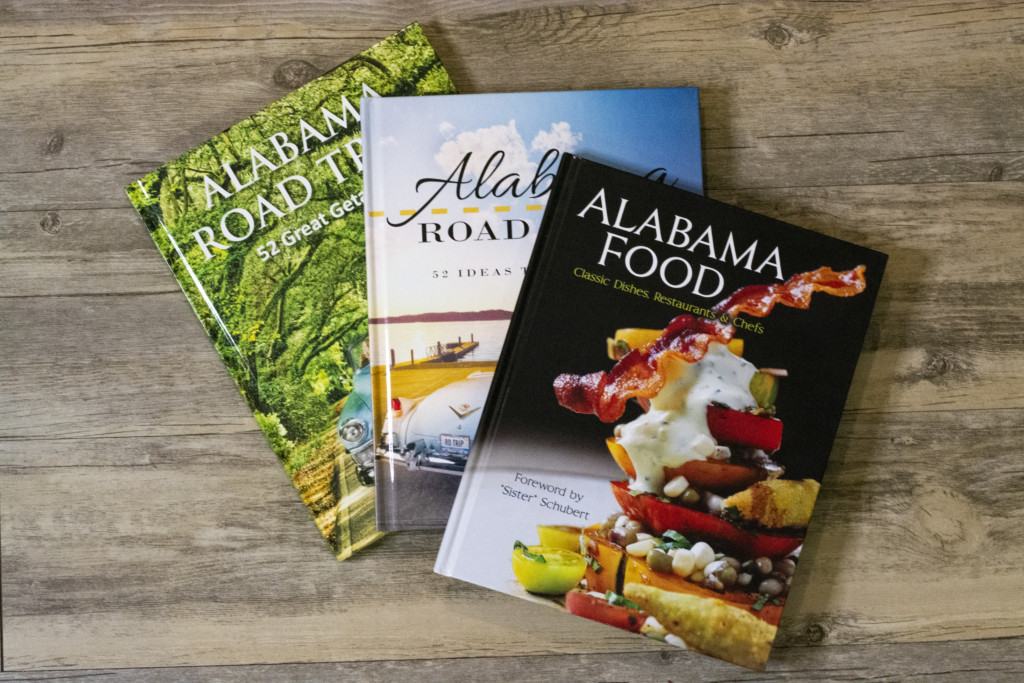
The first book (Alabama Food) set the visual framework that would define the series. Rather than designing a one-off publication, the goal was creating a repeatable system that could accommodate different content types while maintaining brand consistency.
Key design decisions:
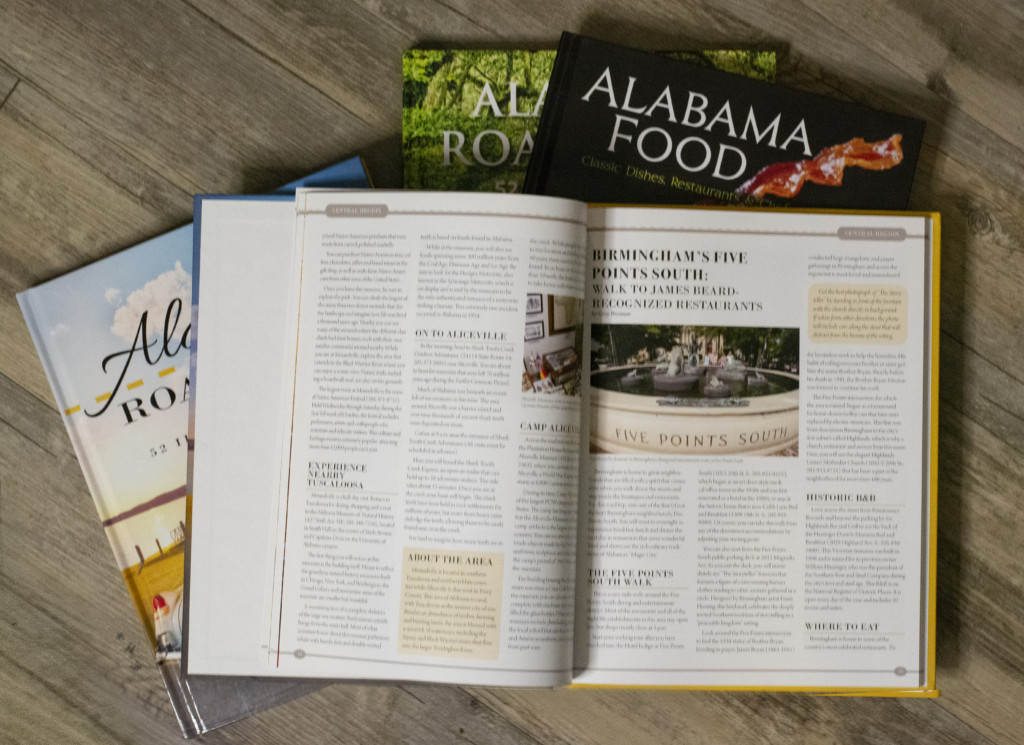
- Three-column grid: Provides flexibility for various content densities—allows large hero images alongside detailed listings, callout boxes, and running text without forcing uniform layouts
- Generous typography: Prioritized readability over density—these are travel guides used in suboptimal lighting conditions (cars, restaurants, outdoor festivals)
- Modular content structure: Designed chapters to support regional trip itineraries, restaurant recommendations, festival listings, and historical anecdotes without requiring custom layouts for each content type
- Photography showcase: High-quality photography was a major asset—layout system needed to feature images prominently while supporting dense information blocks
System Validation and Adoption
The first book’s commercial success (strong sales, multiple reprints) validated the approach. When the Road Trips edition followed the same format and also sold out multiple times, the design system proved its scalability.
Most significant validation: Alabama Department of Tourism adopted this system as their ongoing standard, producing subsequent books (BBQ guide) using in-house staff following the established framework. The design system succeeded not just aesthetically, but operationally—it could be executed by different teams while maintaining consistency.
Project Management Under Pressure
These weren’t leisurely editorial projects—they operated under significant constraints:
- Multiple contributors: Coordinating content from tourism staff, regional experts, photographers, and fact-checkers
- Market-driven deadlines: Publication dates tied to tourism seasons and retail inventory cycles
- Print deadline pressure: Once content was locked, production timelines were non-negotiable
- Update cycles: Road Trips book required complete contact/location verification updates for 2019 edition
Outcome
Commercial Success
- Multiple printings across the series due to strong sales
- National distribution via Amazon alongside statewide retail presence
- Positioned as gift items, not just travel guides—indicating perceived value beyond utility
Operational Success
- Design system adopted as departmental standard
- Internal teams able to produce subsequent books using established framework
- System flexible enough to accommodate different travel themes while maintaining brand consistency
Long-term Impact
Completed three books over multiple years (Food, Road Trips updated edition, and supported BBQ guide development), demonstrating the system’s sustainability and the client relationship’s strength.
What This Project Demonstrates
Systems Thinking: Created a design framework that succeeded beyond the initial project—scalable, teachable, and sustainable for internal teams.
Complex Project Management: Coordinated large-scale editorial projects with multiple stakeholders, hard deadlines, and market pressure—delivered consistently on time and on brand.
User-Centered Design: Made layout decisions based on how travelers would actually use the books (quick reference, sustained reading, varied lighting conditions), not just aesthetic preferences.
Strategic Longevity: The design system’s multi-year adoption proved its value—success measured not just in the first book, but in the client’s continued investment and internal adoption.
Commercial Understanding: Designed for retail viability—books needed to succeed as products, not just information delivery vehicles.
Complete set showing visual consistency across the guidebook series
Interior spreads demonstrating three-column grid flexibility and typography hierarchy
Related Work
Other hardbound book projects demonstrating editorial design and production expertise:
- First Light Women’s Shelter History Book
- The Right Place at the Right Time: Memoirs of Warren B. Lightfoot
- Hallowed Ground
- Knesseth Israel History Book
Need design systems that scale beyond the initial project? Let’s discuss your requirements.